RESISTORS

TYPES
Resistors are fundamental components in electronic circuits, designed to limit or regulate the flow of electrical current. They come in various types, each with unique characteristics suited for different applications. The main types of resistors include:
-
Carbon Composition Resistors: Known for their durability and wide resistance range, these resistors are commonly used in high-voltage applications.
-
Metal Film Resistors: These offer excellent precision and stability, making them ideal for applications requiring accurate resistance values.
-
Wirewound Resistors: Built for high power dissipation, these resistors are used in power supplies and audio applications.
-
Surface Mount Resistors (SMD): Compact and suitable for automated assembly, these resistors are widely used in modern electronic devices.
-
Variable Resistors (Potentiometers): These allow for adjustable resistance, used in applications such as volume controls and tuning circuits.
Understanding the different types of resistors and their specific uses is crucial for selecting the right component for your electronic design projects.

IDENTIFICATION THRU HOLE
Understanding the resistor colour code is essential for identifying the resistance value, tolerance, and sometimes the reliability of a resistor. The colour code is a system of coloured bands painted on the body of a resistor, each representing a specific digit, multiplier, or tolerance level. Typically, a resistor has four to six bands:
-
First Two Bands (Digits): These represent the first two significant digits of the resistor's value.
-
Third Band (Multiplier): This indicates the factor by which the first two digits should be multiplied.
-
Fourth Band (Tolerance): This shows the resistor's tolerance, indicating how much the actual resistance can vary from the stated value.
For example, a resistor with bands of red, violet, yellow, and gold corresponds to a resistance value of 27 (red, violet) multiplied by 10,000 (yellow), with a tolerance of ±5% (gold).
Mastering the resistor color code is a fundamental skill for anyone working with electronic circuits, ensuring accurate identification and application of resistors in your projects.

IDENTIFICATION SMD
Identifying the value of Surface Mount Device (SMD) resistors is crucial for ensuring the correct functionality of electronic circuits. SMD resistors are marked with codes rather than the color bands used in traditional resistors. These codes are typically three or four digits:
-
Three-Digit Code: The first two digits represent the significant figures, and the third digit is the multiplier. For example, a resistor marked "472" has a value of 47 x 10², or 4,700 ohms.
-
Four-Digit Code: The first three digits represent the significant figures, and the fourth digit is the multiplier. For instance, "4703" indicates a value of 470 x 10³, or 470,000 ohms.
EIA-96 Code: Some SMD resistors use a special three-character code with two digits and a letter. The digits represent a specific value from a standardized table, and the letter denotes the multiplier.
Accurately reading these codes is essential for proper component selection and circuit design, ensuring that your electronic projects perform reliably and as intended.
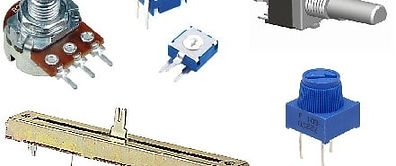
POTENTIOMETERS
Identifying the value of a potentiometer is essential for effectively using this versatile component in electronic circuits. A potentiometer, often abbreviated as "pot," is a variable resistor with three terminals, used to adjust voltage levels, signal levels, or other parameters within a circuit.
Resistance Value: The total resistance value is usually printed directly on the body of the potentiometer. It is denoted in ohms (Ω), kilohms (kΩ), or megohms (MΩ). For instance, a marking of "10k" indicates a 10,000-ohm potentiometer.
Tolerance: The tolerance, which indicates how much the actual resistance can vary from the stated value, is often provided as a percentage. This can sometimes be found on the potentiometer or in the manufacturer's datasheet.
Taper Type: The taper type, either linear (denoted by "B" or no letter) or logarithmic (denoted by "A"), describes how the resistance changes with the rotation of the wiper. This information is crucial for understanding the potentiometer's behavior in a circuit.
Understanding these key markings ensures accurate identification and appropriate use of potentiometers, enabling precise control in a wide range of electronic applications.
Enjoy this Tutorial ? Why not send a small donation to say thanks ? All donations go towards producing more project content on this website. Thanks for reading