

Learning Zone
My resource focuses on teaching the fundamentals of electronics, covering topics ranging from basic components like resistors, capacitors, and diodes to more advanced concepts such as circuit design and microcontroller programming.
Whether you're a absolute beginner or a novice eager to explore the world of electronics, you'll find comprehensive explanations and practical insights to guide you through every step of your learning journey.
Hopefully you may also try one of my build it yourself projects and have something new to show for the journey.
The Basics
Voltage
Voltage, also known as electric pressure, electric tension, or potential difference, is the difference in electric potential between two points. In a static electric field, it corresponds to the work needed per unit of charge to move a test charge between the two points
Abbreviation: R
Current
An electric current is a flow of charged particles, such as electrons or ions, moving through an electrical conductor or space. It is defined as the net rate of flow of electric charge through a surface
Abbreviation: I
Resistance
Also called ohmic resistance. a property of a conductor by virtue of which the passage of current is opposed, causing electric energy to be transformed into heat: equal to the voltage across the conductor divided by the current flowing in the conductor: usually measured in ohms. Abbreviation: R
Ohms Law
Ohm's Law is one of the most fundamental and important laws governing electrical and electronic circuits.
Ohm's Law relates current, voltage and resistance for a linear device, such that if two are know, the third can be calculated.
The Calculation
If you know two of the values the third can be calculated easily
Current = Voltage / Resistance
Resistance = Voltage / Current
Voltage = Current x Resistance

All about Resistors

All about Capacitors
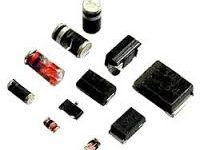
All about Diodes